The AI Wealth Illusion: Why Sri Lanka’s IT Sector is Flying Blind into a Crisis
Anthropic’s recent pledge to put roughly $48 billion in equity into a public benefit fund, and its CEO's push for an AI-funded Universal Basic Income (UBI), aren't just Silicon Valley thought experiments. They are blaring alarm bells. Generative AI is rapidly obliterating the exact jobs Sri Lanka's developing economy relies on for survival.
Go deeper22 min
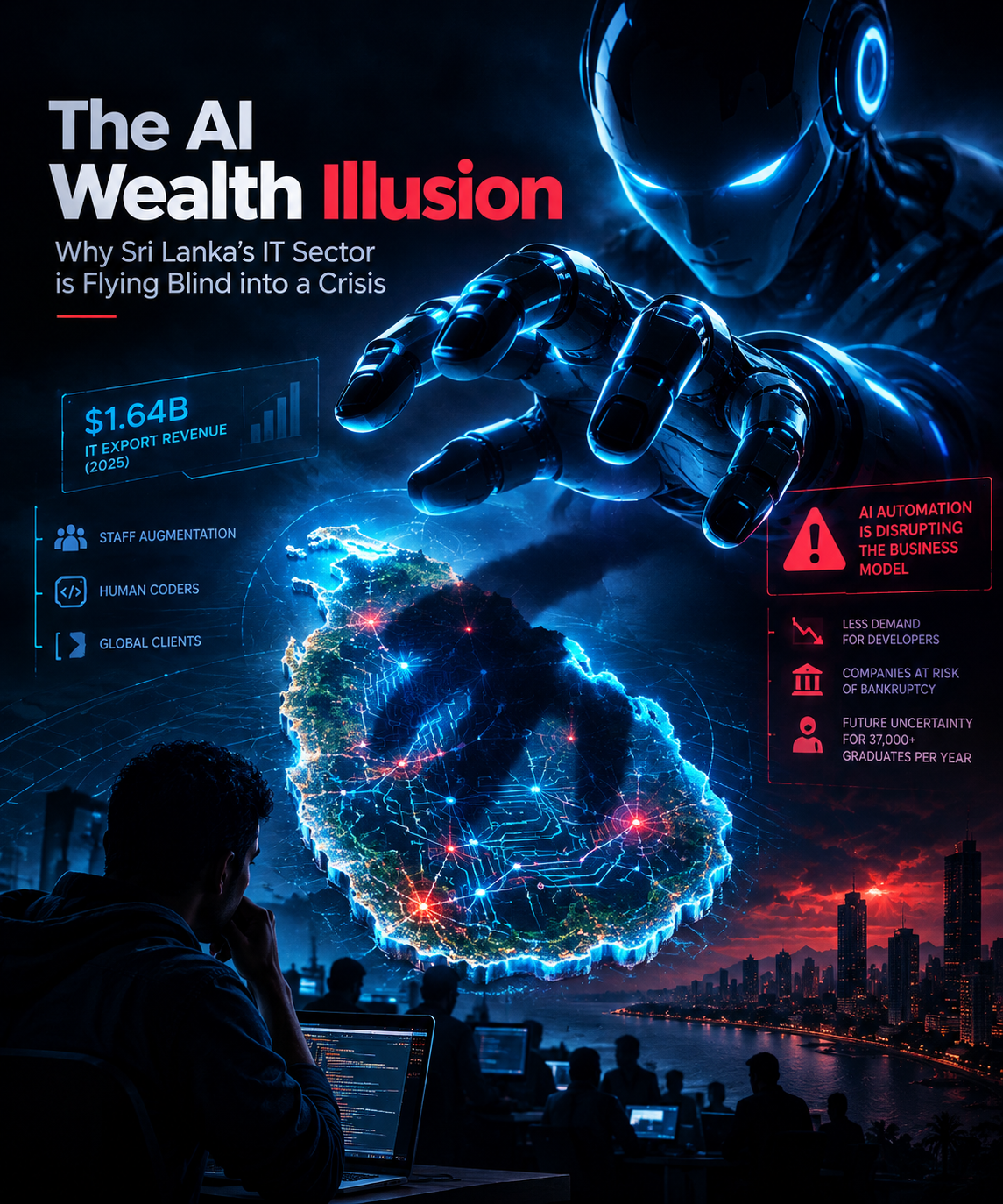
The big picture: Silicon Valley AI giants like Anthropic are actively planning for a future without human labor, proposing concepts like Universal Basic Income (UBI) and dedicating billions in company equity to "Public Benefit Funds" to support displaced workers.
The brutal truth for Sri Lanka: None of that Silicon Valley safety net is guaranteed to reach Sri Lankan citizens. Because these frontier AI labs operate primarily in the US and Europe, any UBI or wealth redistribution will naturally default to the jurisdictions where their offices and tax obligations reside. Sri Lanka currently has no policies, no direct diplomatic agreements, and no international tax levers to force these giants to share their wealth with our displaced workers.
Why it matters: Sri Lanka’s technology sector brought in roughly $1.64 billion in export revenue in 2025. A massive portion of this comes from "staff augmentation", local tech companies renting out the time and skills of human software engineers to overseas clients. Generative AI is obliterating this exact business model.
The cascading risk to IT professionals:
- The End of "Headcount" Billing: Global clients are realizing they no longer need to pay a Sri Lankan firm for a team of ten developers. Armed with AI coding agents, they now demand the same output from a team of three. The days of simply adding more junior coders and billing for their hours are over.
- Corporate Bankruptcies: As overseas clients abruptly cut their outsourced headcount, local staff augmentation companies will see their revenue evaporate overnight. Firms that cannot immediately pivot to selling high-value, outcome-based AI products risk sudden bankruptcy.
- A Workforce Left with Nothing: When these local firms fold, their employees will hit a brick wall. Entry-level IT jobs have already plummeted by 67%, meaning displaced engineers will have nowhere to go.
The policy vacuum: Right now, Sri Lanka is churning out 37,000 IT graduates a year into a market that is fundamentally shrinking. Yet, there is no government safety net designed for a sudden, permanent collapse in tech employment.
- We have not aggressively implemented borderless digital taxes (like the OECD Pillar Two) that could siphon a fraction of AI profits back into our economy.
- We are not actively negotiating in Global South blocs to demand international AI dividend distributions.
The bottom line: While Western tech workers might eventually be cushioned by AI-funded UBI or corporate benefit funds, Sri Lankan tech professionals are completely exposed. If our government does not urgently enact policies to capture global AI wealth and build a domestic safety net, the collapse of our staff augmentation industry won't just cost jobs, it will leave an entire generation of tech workers with nothing.
Go deeperThe full details behind this post, with sources.
Inside: Anthropic’s Economic Policy Framework and Governance Innovations · Macroeconomic Vulnerability and Balance of Payments · Impact on the IT-BPM Sector and Outsourced Staff · Impact on BOI Enterprises and the Apparel Workforce · +13
OpenClose
The full details behind this post, with sources.
Inside: Anthropic’s Economic Policy Framework and Governance Innovations · Macroeconomic Vulnerability and Balance of Payments · Impact on the IT-BPM Sector and Outsourced Staff · Impact on BOI Enterprises and the Apparel Workforce · +13
The Economic and Labor Impacts of AI-Driven Wealth Redistribution on Sri Lanka
The rapid acceleration of generative artificial intelligence (AI) has shifted the global economic discourse from theoretical discussions of automation to immediate, actionable policy interventions. At the forefront of this structural shift is Anthropic, a Delaware Public Benefit Corporation (PBC) whose stated legal mandate is the responsible development of advanced AI for the long-term benefit of humanity1. Following its confidential and subsequent public Form S-1 filings in late 2026, which revealed explosive revenue growth to $16.29 billion in the first half of the year against staggering non-cash losses of $80.7 billion, Anthropic has catalyzed intense international debate regarding extreme wealth concentration and systemic labor displacement1.
To mitigate the socio-economic friction caused by its own frontier models, Anthropic has proposed an unprecedented Economic Policy Framework (EPF) alongside a pledge to dedicate 5% of its fully diluted shares to a newly established Anthropic Public Benefit Fund5. This fund, structured as a wholly owned Limited Liability Company (LLC) rather than a traditional 501(c)(3) nonprofit, is designed to issue direct distributions or support nonprofits, explicitly targeting workers displaced by AI5. Furthermore, Anthropic’s CEO, Dario Amodei, has publicly floated the necessity of taxing AI firms to fund a Universal Basic Income (UBI) and has called for international coordination to manage the pace of labor displacement9.
For Sri Lanka—a nation heavily reliant on human capital exports, outsourced Information Technology (IT) and Business Process Management (BPM) services, and labor-intensive apparel manufacturing—the structural transformation envisioned by Anthropic represents both an existential economic threat and a profound sovereign opportunity. Sri Lanka is navigating a fragile recovery from a severe balance of payments and sovereign debt crisis, rendering its macroeconomic stability highly sensitive to external shocks12. The nation's economic rehabilitation is heavily contingent on export revenues, particularly from the IT-BPM sector, which generated approximately $1.64 billion in 202515. However, recent research from the International Labour Organization (ILO) notes that clerical, administrative, and BPO roles—the very foundation of the developing world's middle-class expansion—are among the most highly exposed to generative AI disruption18.
This comprehensive analysis evaluates the structural implications of Anthropic's EPF, the macroeconomic mechanics of global AI-driven wealth redistribution, the specific vulnerabilities of Sri Lanka's outsourced workforce and Board of Investment (BOI) enterprises, and the strategic policy updates required to protect the nation's citizens over the next ten to fifteen years.
Anthropic’s Economic Policy Framework and Governance Innovations
To understand how Sri Lanka must respond, policymakers must first understand the corporate and philosophical architecture of the entities driving the disruption. Anthropic’s S-1 filing outlines a corporate governance structure with no direct public company precedent, designed specifically to shield its safety and redistribution mandates from traditional shareholder primacy6. A Long-Term Benefit Trust (LTBT), comprised of financially disinterested trustees with expertise in AI safety and public policy, wields significant power, electing four of the company's seven directors4. Furthermore, seven co-founders hold a fixed 50.1% of voting power through a single Class F share, ensuring the company operates as a controlled entity insulated from hostile takeovers that might prioritize short-term profit over labor market stability1.
Through this insulated structure, Anthropic has committed to transferring 5% of its shares (valued at an estimated $48 billion based on the company's $965 billion Series H valuation) to the Anthropic Public Benefit Fund, with provisions to increase the stake by 2% for every 50% increase in baseline valuation5. Combined with founder pledges to donate 80% of their equity and employee matching programs, nearly 20% of Anthropic's capitalization is theoretically earmarked for public benefit7.
The ideological blueprint for deploying this capital is outlined in Anthropic's Economic Policy Framework (EPF), published in June 2026. The EPF outlines a tiered, escalating response to AI-driven labor disruption, indexed to the national unemployment rate11. While drafted with a US focus, Anthropic explicitly states the principles are intended to be global26.
| EPF Tier | Unemployment Trigger | Primary Policy Mechanisms | Logic and Global Implication |
|---|---|---|---|
| Tier 1: Baseline | ~5% (Historical baseline with churn) | Universal pre-distributive capital accounts; wage insurance; occupational licensing reform; retention tax incentives11. | Prepare for disruption by giving citizens a direct equity stake in the AI economy before extreme capital concentration occurs. Subsidize workers transitioning to lower-paying roles11. |
| Tier 2: Recession | ~10% (Recession-level disruption) | Automatic, uniform unemployment insurance extensions; sector-specific transition support; basic needs relief11. | Expand temporary income support; firms may face government regulations applied uniformly at the firm level to actively manage and slow the pace of labor displacement11. |
| Tier 3: Transformative | > Historical Peaks (Transformative) | Universal Basic Income (UBI); AI Sovereign Wealth Funds; broad-based consumption taxes; compute/token levies11. | The link between human labor and income structurally breaks. Systemic redistribution of AI returns becomes mandatory to sustain the global economy11. |
The EPF relies heavily on the concept of "buying time" during Tier 1 to establish the data monitoring and redistribution mechanisms required for Tiers 2 and 311. For an emerging economy like Sri Lanka, the immediate challenge is that statistical agencies do not currently track AI adoption or its labor-market effects with the speed or granularity necessary to trigger these protective tiers effectively11.
Macroeconomic Vulnerability and Balance of Payments
Sri Lanka’s macroeconomic stability is acutely sensitive to exogenous shocks, operating as a small, open economy where isolated global events immediately impact domestic foreign exchange reserves14. Analysts note that a combination of environmental and geopolitical factors—such as a cyclone disrupting tea production in Kandy and conflicts in the Middle East spiking crude oil prices—can rapidly swing the national current account back into deficit14.
The IT and BPM sector has historically functioned as a vital buffer against these shocks. Sri Lanka earned $1.64 billion from ICT/BPM exports in 2025, and high-value service industries drove a 3.75% overall rise in services exports by mid-202615. The Ministry of Digital Economy and GovTech Sri Lanka, guided by KPMG market assessments, recently validated a roadmap targeting $5 billion in IT/ITES exports by 2030, alongside a broader goal of expanding the total digital economy to $15 billion16.
However, this $5 billion export target assumes the global market for outsourced IT services will continue expanding linearly, a premise that the proliferation of generative AI fundamentally contradicts16. The global AI contest carries two contrasting implications for Sri Lanka: an opportunity to deploy AI infrastructure to generate new exports, and a severe disruption to its existing technology-export model built around human-delivered coding and back-office services32. If global corporations leverage Anthropic's Claude or similar models to achieve massive productivity gains, they will require significantly fewer billable hours from offshore vendors. Work that was previously outsourced to Colombo may be brought back in-house to be managed by smaller, AI-augmented internal teams16.
A sudden, AI-driven contraction in global outsourcing demand would severely compromise the country's balance of payments, exacerbating depreciation pressures on the Sri Lankan Rupee12. Furthermore, the International Monetary Fund (IMF) has issued warnings regarding the financial stability of nations rapidly adopting AI and digital payment infrastructures34. While typically framed around cybersecurity and the speed of AI-driven cyberattacks, the broader implication is that systemic technological disruption can paralyze financial systems even when underlying bank balance sheets remain sound34. For Sri Lanka, maintaining foreign exchange stability is inextricably linked to maintaining the relevance of its human capital exports in the face of autonomous AI agents.
Impact on the IT-BPM Sector and Outsourced Staff
The most immediate domestic casualty of the AI revolution is the traditional entry-level pathway in the IT-BPM sector. Sri Lanka's educational institutions currently produce approximately 37,000 IT-related graduates annually35. Despite this output, data from the Sri Lanka Association of Software and Service Companies (SLASSCOM) and industry analysts indicate that only about 17,000 of these graduates meet baseline industry employability standards35. Crucially, as of 2025, the market generated only an estimated 11,000 entry-level positions, resulting in a graduate-to-job ratio of 3.4 to 1 and leaving tens of thousands of graduates structurally unemployed or underemployed35.
This oversupply has collided with the widespread adoption of AI coding tools, leading to a 67% reduction in entry-level opportunities35. Historically, a software engineering graduate would enter the industry as a junior coder or quality assurance (QA) tester, spending years learning a client's business while performing routine tasks16. Generative AI has abruptly eliminated this apprenticeship runway. Companies like Cut+Dry and hSenid Business Solutions in Sri Lanka report that tasks that previously took new hires months to comprehend can now be managed by AI agents trained on proprietary codebases in a matter of weeks33. Consequently, clients demand smaller, leaner, AI-augmented teams and expect outcome-based pricing rather than traditional headcount billing33.
The profile of the desired tech worker has fundamentally shifted. Employers no longer seek developers whose primary skill is memorizing programming syntax; they demand "builders"33. A builder acts as an orchestrator who understands complex business domains, meets directly with clients, conceptualizes solutions, and uses AI agents to rapidly generate and test the actual code33. Graduates who lack cross-disciplinary communication skills and practical AI fluency are finding themselves entirely locked out of the market35.
The International Labour Organization (ILO) corroborates this micro-trend on a macroeconomic scale. In its comprehensive 2025 and 2026 updates evaluating nearly 30,000 tasks at the ISCO-08 4-digit occupational level, the ILO found that while one in four workers globally face some degree of generative AI exposure, the impacts are highly stratified by geography and occupation19. The highest density of automation risk is concentrated among clerical, administrative, and customer support workers—the very roles that constitute the bulk of the Global South's BPO sector19. While advanced economies may transition these workers into new AI-augmented analytical roles, developing economies risk losing these vital clerical jobs before they have secured the digital infrastructure and broadband reliability necessary to pivot toward higher-value AI engineering18.
Impact on BOI Enterprises and the Apparel Workforce
Beyond the digital economy, the physical manufacturing base governed by the Board of Investment (BOI) faces a parallel, albeit distinct, transformation. The BOI accounts for 85% of Sri Lanka's national industrial exports, predominantly driven by the apparel and textile sector, which generates between $3 billion and $4 billion annually and employs hundreds of thousands of factory workers across various Export Processing Zones42.
Historically, the pliable nature of fabric made apparel manufacturing highly resistant to robotic automation, preserving the necessity of human sewing machine operators. However, AI disruption in this sector is currently circumventing physical manipulation by automating complex cognitive and visual tasks. Sri Lankan apparel conglomerates are increasingly deploying AI vision systems and camera-based defect inspection technologies44. These AI models compare printed fabric sections against intended pattern geometries in real-time, autonomously flagging registration drift, broken stitches, and print quality deviations with a speed and accuracy that human quality-control inspectors cannot match44.
While fully autonomous "sewbots" are not yet replacing the entire factory floor, the integration of predictive AI for supply chain management and automated visual inspection directly reduces the demand for routine quality assurance, middle-management logistics, and clerical tracking staff45. If the Sri Lankan apparel sector fails to aggressively adopt these AI efficiencies, it faces an existential competitiveness crisis against rival nations that are heavily subsidizing automated manufacturing48. Conversely, successful adoption will inevitably displace a segment of the traditional factory workforce, necessitating a strategic pivot toward machine maintenance, automated system oversight, and sustainable garment engineering46.
Global Wealth Redistribution and Digital Neocolonialism
As AI hollows out entry-level IT and routine manufacturing roles, Sri Lanka must address the macroeconomic reality that the wealth generated by these efficiencies will compound almost exclusively in advanced economies, primarily within the United States. This dynamic threatens to entrench a system of "digital neocolonialism," wherein the Global South provides raw data, training labor, and market consumption, while the intellectual property, capital concentration, and equity returns are monopolized by Western frontier labs49.
Anthropic's proposed Tier 1 solution—universal pre-distributive capital accounts—attempts to address this by seeding financial accounts with AI equity11. However, implementing this globally poses severe logistical and political challenges. If AI automation destroys traditional BPO jobs in Sri Lanka, the domestic tax base will shrink proportionally. In the United States, labor earns a falling share of total income but pays roughly 70% of federal taxes; a collapse in labor income translates directly to a collapse in government revenue52. Consequently, Sri Lanka cannot fund a domestic Universal Basic Income or comprehensive welfare state solely by taxing domestic consumption, as the required capital simply will not exist within its borders53.
To access the staggering wealth generated by AI, Sri Lanka must advocate for international redistribution mechanisms. Global tax researchers and economists have proposed mechanisms such as a "Scrip Levy in Shares," essentially a liquid wealth tax52. Under this model, large global corporations are required to pay an annual levy denominated in newly issued, non-voting shares into an international public benefit trust or social wealth fund52. By starting with a baseline floor of 1% of equity, this system naturally captures future dilution and grows automatically with the valuation of the AI economy, avoiding the cash-flow disruptions and valuation gaming that plague traditional corporate taxes52. Crucially, to prevent capital flight, this tax is enforced based on market access rather than corporate domicile; a company cannot avoid the levy by moving offshore if it wishes to sell its AI services in participating jurisdictions52.
Sri Lanka's diplomatic apparatus must aggressively participate in international forums to champion these models. The nation must align with Global South blocs to demand that funds like the Anthropic Public Benefit Fund do not exclusively distribute dividends to American workers, but establish mechanisms to compensate developing nations whose economic advancement has been structurally foreclosed by foreign AI monopolies5.
Updating Sri Lankan Policy for the AI Transition (0-5 Years)
To prepare for Anthropic's EPF Tier 1 and Tier 2 scenarios, Sri Lanka must rapidly implement domestic policy updates, modernizing its tax infrastructure and social security systems.
Operationalizing the National Digital Economy Strategy
The government has laid foundational groundwork through the National Digital Economy Strategy 2030 and the National AI Strategy, backed by an initial LKR 1 billion allocation for AI advancement54. The overarching goal is to elevate the digital economy from approximately 4% of GDP to over 12%, while leapfrogging in global digital-economy indices30.
To move from strategy to execution, Sri Lanka must immediately pass the Digital Economy Act and empower the proposed Digital Economy Authority (DEA) alongside GovTech Sri Lanka30. The DEA must act as the regulatory custodian, ensuring that Digital Public Infrastructure (DPI)—such as a Unique Digital Identity, verifiable credentials, and national data exchanges—is rolled out swiftly to facilitate seamless government transactions30. Successful pilots, such as the GovPay system which achieved Rs 2 billion in digital transaction value across thousands of government services, demonstrate the viability of this infrastructure31. However, the National AI Strategy must be updated to explicitly include legal frameworks for labor protection and data sovereignty, ensuring foreign AI entities cannot exploit domestic data without providing reciprocal economic benefits54.
Implementing OECD Pillar One and Pillar Two
Simultaneously, Sri Lanka must aggressively integrate with the OECD's international tax frameworks to capture revenue from borderless digital services58. The OECD Pillar Two framework establishes a Global Minimum Tax (GMT) of 15% on multinational enterprises with annual revenues exceeding EUR 750 million61. More importantly for developing nations, it includes the Subject to Tax Rule (STTR), allowing jurisdictions to update bilateral tax treaties and "tax back" specific intra-group payments that are subject to low nominal rates elsewhere61.
While implementation of Pillar One (reallocating taxing rights to market jurisdictions) has stalled globally, the adoption of Pillar Two is advancing rapidly across Europe, Canada, and Australia63. Sri Lanka must draft domestic legislation aligned with the OECD's GloBE (Global Anti-Base Erosion) rules to ensure it captures the top-up tax on major tech and AI conglomerates operating within its borders, rather than allowing those revenues to revert to the companies' home countries63. Concurrently, the Inland Revenue Department should leverage AI for internal digital transformation, moving toward predictive Compliance Risk Management (CRM) to reduce administrative burdens on local businesses while closing the tax gap66.
Reimagining the EPF and ETF as Pre-Distributive Capital Accounts
Sri Lanka’s private-sector social safety net is anchored by the Employees' Provident Fund (EPF) and the Employees' Trust Fund (ETF). Employers contribute 12% to the EPF and 3% to the ETF, while employees deduct 8% of their earnings for the EPF69.
Anthropic’s framework highlights the necessity of "universal pre-distributive capital accounts" that compound over time, giving citizens a direct stake in AI-driven economic growth11. Sri Lanka should strategically restructure the investment portfolios of the EPF and ETF. Instead of purely holding domestic government bonds and local equities, a portion of these funds must be diversified into global technology indices, AI infrastructure assets, or international AI sovereign wealth instruments. If the DEA negotiates infrastructure or data agreements with global AI labs, it should demand compensation in the form of corporate equity deposited directly into the ETF, thereby mutualizing the returns of global AI advancement for the Sri Lankan workforce.
Additionally, policymakers should establish "wage insurance" mechanisms as proposed in the EPF11. If displaced BPO workers are forced into lower-paying domestic service roles, wage insurance would temporarily subsidize the income disparity, preventing catastrophic drops in consumer spending and managing the socio-economic fallout of structural transition11.
A 10-to-15-Year Horizon for Citizen Protection
Looking toward the late 2030s, the assumption that human labor will remain the primary engine of economic value is highly precarious. Sri Lanka must plan for Anthropic's Tier 3 scenario, wherein unemployment exceeds historical peaks and the link between labor and survival is permanently severed11.
Universal Basic Services (UBS) and Universal Basic Compute (UBC)
While Silicon Valley executives frequently champion a cash-based Universal Basic Income (UBI), distributing unconditional cash in a post-debt-default, developing economy like Sri Lanka is a recipe for hyperinflation and currency collapse53. Instead, Sri Lanka's 15-year roadmap must pivot toward Universal Basic Services (UBS) and Universal Basic Compute (UBC).
| Distribution Model | Mechanism | Strategic Advantage for Sri Lanka | Limitations |
|---|---|---|---|
| Universal Basic Income (UBI) | Unconditional, recurring cash transfers to all adult citizens53. | Maximizes individual autonomy and market flexibility; eliminates bureaucratic means-testing73. | Fiscally impossible for emerging economies without massive, reliable infusions of foreign capital via global taxation53. |
| Universal Basic Services (UBS) | Guaranteed state provision of essential services: healthcare, housing, transport, internet, and energy73. | Directly targets fundamental human needs; leverages and expands existing state infrastructure (e.g., free public healthcare)73. | Vulnerable to public sector inefficiency and corruption; requires robust physical infrastructure investment. |
| Universal Basic Compute (UBC) | Providing citizens with subsidized or free access to AI models, cloud compute, and data resources73. | Shifts the paradigm from passive welfare to active ownership; democratizes the "means of production" for the AI era73. | Highly dependent on international supply chains for GPUs and massive energy grid requirements73. |
By guaranteeing UBS, the state ensures that extreme poverty is eradicated regardless of labor market conditions. By providing UBC, the state empowers its citizens to become entrepreneurs and creators in the AI economy, rather than mere digital dependents73. Achieving this requires aggressive state investment in sovereign data centers and renewable energy infrastructure to support the immense power demands of localized AI processing.
Overhauling the Educational Paradigm
The current crisis in graduate employability proves that incremental changes to university curricula are insufficient. Sri Lanka must fundamentally restructure its educational pipeline. The focus must shift away from rote memorization of programming syntax and routine clerical procedures, which are now seamlessly executed by AI agents33.
The curriculum of the 2030s must prioritize AI orchestration, prompt engineering, systems architecture, and deep domain-specific knowledge (e.g., FinTech, AgriTech, specialized logistics). Furthermore, human-centric skills that are highly resistant to automation—such as complex negotiation, ethical oversight, hands-on physical trades, and high-empathy care work—must be elevated in national vocational training programs37. As noted by educational analysts, an accountant who merely processes numbers is highly vulnerable, whereas an accountant who leverages AI data analysis to provide strategic business counsel remains indispensable75. Treat AI literacy not as a specialization, but as a mandatory baseline skill across all disciplines75.
International Countermeasures and Strategic Benchmarking
Sri Lanka is not navigating this disruption in a vacuum. Analyzing the responses of competitor nations and advanced economies provides actionable blueprints for strategic adaptation.
The Philippines: Aggressive BPO Upskilling
The Philippines, Sri Lanka’s primary competitor in the global IT-BPM market, has proactively acknowledged the AI threat. The Information Technology and Business Process Association of the Philippines (IBPAP) previously established a massive vision of a $59 billion industry employing 2.5 million workers by 202876. However, recognizing that generative AI will hollow out routine voice-based customer service and low-level clerical roles, IBPAP has engaged in significant downward revisions of its roadmap78.
To counter this, the Philippine government, primarily through the Department of Labor and Employment (DOLE) and the Technical Education and Skills Development Authority (TESDA), is executing targeted upskilling programs to transition workers away from easily automated tasks80. The strategic pivot focuses on capturing higher-value global capability centers, emphasizing healthcare information management, data governance, and cybersecurity81. Sri Lanka's SLASSCOM and BOI must mimic this state-backed, aggressive reskilling apparatus, formally acknowledging that lower-tier BPO expansion is no longer a viable growth strategy.
Singapore: Jobs Transformation Maps (JTMs)
Singapore offers a highly structured, empirical approach to labor transitions through its Jobs Transformation Maps (JTMs)83. Published under the national SkillsFuture movement, JTMs are granular, sector-specific studies developed in collaboration with industry and unions84. They project exactly how specific job roles will evolve over a 3-to-5-year horizon due to technological integration, providing employers with recommended pathways for job redesign and workforce reskilling83. For instance, the Infocomm Media Development Authority (IMDA) is utilizing these maps to actively reskill 18,000 professionals in AI and adjacent digital skills85.
Sri Lanka’s Ministry of Technology should establish a localized version of JTMs for its most critical export sectors (IT, Apparel, Tea, and Tourism). By providing companies with precise data on which tasks will be automated and which adjacent skills require human operators, the government can preempt mass layoffs and optimize corporate training budgets.
The United States and the Sovereign Wealth Fund Debate
In the United States, policy discourse has accelerated beyond regulatory frameworks to massive structural interventions. Political figures across the ideological spectrum are debating the creation of an American AI Sovereign Wealth Fund86. Proposals range from levying a one-time 50% tax on major AI firms to transfer private stock to the public, to utilizing state investments in AI technologies to fund a universal basic income for citizens86.
During recent AI roundtables, such as the Vertesia platform experiment simulating global debates, concepts like the "Geneva Framework" emerged, proposing a Global AI Revenue Authority (GAIRA) under UN oversight to distribute AI tax revenues internationally88. While Sri Lanka lacks the geopolitical leverage to expropriate equity from Silicon Valley unilaterally, it must align itself with these global movements. By positioning itself alongside other Global South nations, Sri Lanka can advocate for an international regulatory framework that treats AI advancement as a global utility, ensuring that the unprecedented wealth generated by these technologies is distributed equitably to the populations whose labor markets they disrupt.
Works cited
- Anthropic IPO - AlphaSense, https://www.alpha-sense.com/anthropic_dashboard/
- Company \ Anthropic, https://www.anthropic.com/company
- Anthropic IPO prospectus: 10 key takeaways for investors on revenue, losses and governance, https://www.financialexpress.com/market/global-markets/anthropic-ipo-prospectus-10-key-takeaways-for-investors-on-revenue-losses-and-governance/4369896/
- Anthropic (ANT) S-1 IPO SEC Filing Analysis, https://sec-api.io/insights/anthropic-ant-s-1-ipo-sec-filing-analysis
- Anthropic proposes giving 5% of its shares to a public benefit fund, https://www.therundown.ai/news/anthropic-public-benefit-fund-equity-pledge
- Anthropic, PBC - S-1 (Q2) - SEC.gov, https://www.sec.gov/Archives/edgar/data/2130357/000162828026067168/anthropicpbc-sx1.htm
- Anthropic Creates Public Benefit Fund, Pledges 5% of Its Equity, https://www.binance.com/en-TR/square/post/378790912918752
- Investing in the public benefit - Anthropic, https://www.anthropic.com/news/public-benefit-fund
- Anthropic pledges $200 million to research AI's economic impact as, https://apnews.com/article/anthropic-dario-amodei-ai-afeb5279eef406980dffa46ff91495e0
- Anthropic CEO Floats Tax on AI Firms to Fund Universal Income, https://www.reddit.com/r/Futurology/comments/1u4vpfu/anthropic_ceo_floats_tax_on_ai_firms_to_fund/
- Anthropic Economic Policy Framework (June 2026), explained, https://go-to-agency.com/en/blog/anthropic-economic-policy-framework-ai-jobs-2026
- Sri Lanka's Balance of Payments Crisis | PDF - Scribd, https://www.scribd.com/presentation/566905310/Balance-of-Payments-and-Sri-lanka-case-study
- (PDF) The Potential of Artificial Intelligence Adoption in Mitigating, https://www.researchgate.net/publication/382242672_The_Potential_of_Artificial_Intelligence_Adoption_in_Mitigating_the_Economic_Crisis_in_Sri_Lanka_A_Case_Study
- Why an AI-tech bubble could decide Sri Lanka's next crisis | Daily FT, https://www.ft.lk/columns/From-ICU-to-Stock-Exchange-Why-an-AI-tech-bubble-could-decide-Sri-Lanka-s-next-crisis/4-794766
- Sri Lanka IT Industry in 2026: Growth, Jobs, Exports & Skills, https://hashtagcoders.lk/blogs/tech-industry-growth-opportunities-sri-lanka-2026
- Sri Lanka's $5 Billion IT Export Target by 2030 - Medium, https://medium.com/@anjanasamindraperera/sri-lankas-5-billion-it-export-target-by-2030-unrealistic-ambition-amid-a-shrinking-it-industry-59efa4a856da
- Sri Lanka's IT and BPM exports hit $1.645 billion in 2025, https://techdestinationsrilanka.lk/stories/it-bpm-exports-2025/
- Artificial Intelligence, Automation and the Restructuring of the Global, https://www.researchgate.net/publication/414706803_Artificial_Intelligence_Automation_and_the_Restructuring_of_the_Global_Labour_Market_Occupational_Displacement_Human-AI_Complementarity_and_the_Future_of_Work_Beyond_2035
- Generative AI and Jobs - International Labour Organization, https://www.ilo.org/sites/default/files/2025-05/WP140_web.pdf
- 2025 - OIT - Generative AI and Jobs - A 2025 Update | PDF - Scribd, https://www.scribd.com/document/1064077899/2025-OIT-Generative-AI-and-Jobs-A-2025-Update
- Anthropic Files S-1 for Proposed IPO: What We Know, https://www.blockchain-council.org/claude-ai/anthropic-files-s-1-for-proposed-ipo/
- Anthropic Long-Term Benefit Trust Explained for Claude Users, https://www.layer3labs.io/guides/anthropic-long-term-benefit-trust
- Anthropic IPO: Voting Rights and Share Structure - Luminix AI, https://www.useluminix.com/reports/company-overviews/anthropic-s1-what-the-filing-shows/source/3
- Anthropic Commits 5% Equity to Public Benefit Fund Amid Musk's, https://a47news.ai/story/tech/44753/anthropic-equity-commitment-public-benefit-fund
- Anthropic Wants Wall Street To Bet on AI, but Its IPO Filing Comes With an $80.7 Billion Loss, https://www.techtimes.co.uk/anthropic-files-us-ipo-nasdaq-ant-1809457
- Anthropic's Economic Policy Framework - Regulations.ai, https://regulations.ai/governance/positions/RAIC-ANTHROPIC-ECONOMI-2026
- Anthropic's Economic Policy Framework, https://www-cdn.anthropic.com/files/4zrzovbb/website/9ea607a5dd67c168093829b701f3a0a6d21156d5.pdf
- AI at mid-June, 2026. Where are we at right now? | by Rob Manson, https://medium.com/@robman/ai-at-mid-june-2026-a137d431d663
- Sri Lanka services exports rise 3.75-pct in June 2026, driven by, https://economynext.com/sri-lanka-services-exports-rise-3-75-pct-in-june-2026-driven-by-financial-services-ict-279154/
- Sri Lanka's Digital Economy Blueprint | ICTA, https://www.icta.lk/icta-assets/uploads/2025/10/digital-economy-blueprint-2026-01-21_1768987510_69709b768efd5.pdf
- Sri Lanka Information Technology Industry - LankaBIZ, https://lankabizz.net/industry-intelligence/information-technology/
- AI disruption puts Sri Lanka's IT export model under pressure, https://www.ft.lk/business/AI-disruption-puts-Sri-Lanka-s-IT-export-model-under-pressure/34-796787
- Sri Lanka Trains 17,000 Coders A Year For Jobs AI Is Erasing, https://echelon.lk/sri-lanka-trains-17000-coders-a-year-for-jobs-ai-is-erasing/
- AI Cyber Risks in Sri Lanka: Why the IMF Warning Matters, https://ceylonpublicaffairs.com/ai-cyber-risks-sl-financial-stability/
- The Sri Lankan IT Entry-Level Job Market Analysis (2022-2025), https://mydiary.msanjana.com/articles/sri-lanka-it-market-report-2025
- Sri Lanka hits 17,000 annual IT graduate target as industry turns, https://www.dailymirror.lk/breaking-news/Sri-Lanka-hits-17-000-annual-IT-graduate-target-as-industry-turns-focus-to-AI-upskilling/108-325508
- Graduate Unemployment in Sri Lanka: Are Degrees Keeping Up, https://ceylonpublicaffairs.com/graduate-unemployment-in-sri-lanka-ai-jobs/
- The Automation of Ambition: When AI Eats Entry-Level Roles, https://echelon.lk/the-automation-of-ambition-when-ai-eats-entry-level-roles/
- Global Employment Trends for Youth 2026: Back to the future, https://www.ilo.org/sites/default/files/2026-08/9789220437612_PDFA_Web_ENG.pdf
- CHANGING LANDSCAPE OF SKILLS IN THE AGE OF AI, https://www.ilo.org/sites/default/files/2026-08/Final%20version_IAG%20paper_AI%27s%20impact%20on%20skills%20demand_0.pdf
- Four Scenarios for How AI Will Affect Jobs, https://research.mental-momentum.ai/r/four-scenarios-how-ai-will-affect-jobs-1nayqr
- Annual Exports – Sri Lanka Apparel, https://www.srilankaapparel.com/data-center/yearly-performance/
- Apparel & Textile Sector - Board of Investment of Sri Lanka, https://investsrilanka.com/wp-content/uploads/2025/11/Apparel-Textile-Sector-2025-min.pdf
- AI Vision Textile & Fabric Defect Inspection, https://ifactoryapp.com/ai-vision-camera/ai-vision-textile-fabric-defect-inspection
- AI Visual Inspection for Garment Production, https://www.researchpublish.com/papers/ai-visual-inspection-for-garment-production
- Rhetoric and reality of artificial intelligence in apparel sector in Sri, https://www.researchgate.net/publication/388220363_Rhetoric_and_reality_of_artificial_intelligence_in_apparel_sector_in_Sri_Lanka_comparative_case_study
- Apparel Exports Boom with Predictive AI, But Routine, https://mobiz.lk/si/blog/web-design/apparel-exports-boom-with-predictive-ai-but-routine-factory-jobs-decline-in-sri-lanka
- Sri Lanka's Apparel Industry Faces Automation Crisis As Rivals Surge, https://lankanewsweb.net/archives/267260/sri-lankas-apparel-industry-faces-automation-crisis-as-rivals-surge/
- Artificial Intelligence Bias and Digital Colonialism in Global South AI, https://www.researchgate.net/publication/395993245_Decolonizing_Algorithms_Artificial_Intelligence_Bias_and_Digital_Colonialism_in_Global_South_AI_Governance
- The hidden cost of AI: Digital colonialism and the Global South, https://waccglobal.org/the-hidden-cost-of-ai-digital-colonialism-and-the-global-south/
- Generative AI and digital neocolonialism in global education, https://www.jdet.net/download/generative-ai-and-digital-neocolonialism-in-global-education-towards-an-equitable-framework-17862.pdf
- Who Owns the AI Economy? | Silviu Pitis, https://silviupitis.com/blog/2026/who-owns-the-ai-economy/
- How close are we to Universal Basic Income? - Finshots, https://finshots.in/archive/how-close-are-we-to-universal-basic-income/
- Sri Lanka's 2028 AI National Strategy | PDF | Artificial Intelligence, https://www.scribd.com/document/962897277/National-AI-strategy-for-Sri-Lanka-08a88c78d541a0746aeb8c71ed312231
- National-Digital-Economy-Strategy-2030-Sri-Lanka, https://www.digitaldevelopment.org/wp-content/uploads/2024/04/National-Digital-Economy-Strategy-2030-Sri-Lanka-bc77184e0b6035d235cd0bb1ebf75707.pdf
- Sri Lanka developing an elaborate AI strategy for economic expansion, https://www.biometricupdate.com/202507/sri-lanka-developing-an-elaborate-ai-strategy-for-economic-expansion
- Supporting the development of the National Artificial Intelligence (AI, https://www.citralab.lk/work/supporting-the-development-of-the-national-artificial-intelligence-ai-strategy-for-sri-lanka
- Cross-border and international tax | OECD, https://www.oecd.org/en/topics/policy-issues/cross-border-and-international-tax.html
- Digital government - OECD, https://www.oecd.org/en/topics/policy-issues/digital-government.html
- Taxing digital economies: Development Co-operation Report 2021, https://www.oecd.org/en/publications/development-co-operation-report-2021_ce08832f-en/full-report/component-27
- Cross-border and international tax | OECD, https://www.oecd.org/en/topics/cross-border-and-international-tax.html
- Subject to tax rule: Tax Challenges Arising from Digitalisation - OECD, https://www.oecd.org/en/publications/tax-challenges-arising-from-digitalisation-report-on-pillar-two-blueprint_abb4c3d1-en/full-report/component-12.html
- Pillar Two Developments Tracker: 2026 – oecdpillars.com, https://oecdpillars.com/pillar-two-developments-tracker-2026/
- US resists Digital Services Tax on AI - vatcalc.com, https://www.vatcalc.com/global/us-resists-digital-services-tax-on-ai/
- OECD fears developing countries will struggle in digital tax race, https://www.internationaltaxreview.com/article/2bnjp4huxrg3jx82vojk0/oecd-fears-developing-countries-will-struggle-in-digital-tax-race
- Artificial Intelligence in tax administration: From early innovation to, https://www.oecd.org/en/blogs/2026/04/artificial-intelligence-in-tax-administration-from-early-innovation-to-modern-transformation.html
- Digital transformation of tax administration | OECD, https://www.oecd.org/en/topics/digital-transformation-of-tax-administration.html
- Tax Administration Digitalisation and Digital Transformation Initiatives, https://www.oecd.org/en/publications/tax-administration-digitalisation-and-digital-transformation-initiatives_c076d776-en.html
- EPF and ETF Calculator Sri Lanka (8%, 12%, 3%) | Dr. Dulan Dias, https://www.dulandias.com/calculators/epf-etf-calculator
- Sri Lanka Tax and Payroll 2026 | EPF, ETF, PAYE - Teamed.Global, https://www.teamed.global/country-hiring-guides/sri-lanka/tax-and-payroll
- Sri Lanka Payroll Calculator 2025-2026 - Better HR, https://www.betterhr.com/tools/sri-lanka-payroll-calculator
- Economic Futures Research Fund agenda - Anthropic, https://www.anthropic.com/news/economic-futures-research-fund-agenda
- The Bridge to Abundance - Synthetic: Leadership Intelligence, https://synthetic.stevebrown.ai/p/the-bridge-to-abundance
- Here's How To Share AI's Future Wealth - Noema Magazine, https://www.noemamag.com/heres-how-to-share-ais-future-wealth/
- Which Jobs Are Safe From AI in Sri Lanka? (2026 Guide), https://careercampus.lk/jobs-safe-from-ai-sri-lanka-2026/
- Philippine IT-BPM Industry Roadmap 2028 - Admin - IBPAP, https://admin.ibpap.org/storage/hub-resources/1fntWJGQKvZg4CfwP4yfXs0Jr1n85DVR1vYXJvSn.pdf
- BPO market update: a plan for the future - MicroSourcing, https://www.microsourcing.com/resources-hub/bpo-market-update-a-plan-for-the-future
- IBPAP Roadmap 2028: The Revised Targets vs the Originals, https://bpoai.ai/news/ibpap-roadmap-philippines-2026
- AI, global competition force Philippines' IT-BPM industry to cut targets, https://bworldonline.com/top-stories/2026/07/15/763409/ai-global-competition-force-philippines-it-bpm-industry-to-cut-targets/
- Philippines to reskill 10000 BPO workers for AI - Outsource Accelerator, https://news.outsourceaccelerator.com/philippines-reskill-bpo-ai/
- With AI booming, new skills needed in IT-BPM sector | The Manila, https://www.manilatimes.net/2026/10/29/tmt-anniversary/with-ai-booming-new-skills-needed-in-it-bpm-sector/2456322
- AI plan targets higher-value Philippine jobs - SunStar, https://www.sunstar.com.ph/cebu/ai-plan-targets-higher-value-philippine-jobs
- Jobs Transformation Maps (JTMs) - SWDA, https://www.swda.gov.sg/home/employers-industry-partners/jobs-transformation-maps
- Jobs Transformation Maps (JTM) Singapore - BizGrants Consulting, https://bizgrants.consulting/blog/jobs-transformation-maps/
- Jobs Transformation Map - Singapore - IMDA, https://www.imda.gov.sg/how-we-can-help/techskills-accelerator-tesa/jobs-transformation-map
- America's New $2 Trillion Sovereign Wealth Fund - First Movers, https://firstmovers.ai/sovereign-wealth-fund/
- An AI sovereign wealth fund. - Tangle News, https://www.readtangle.com/government-ownership-ai-companies-bernie-sanders-trump/
- Beyond Borders: How AI Roundtables Are Redefining Global Debate, https://vertesiahq.com/blog/beyond-borders-how-ai-roundtables-are-redefining-global-debate