What’s Actually Happening to the "Sexiest Job of the 21st Century"?
The big picture: In 2012, the Harvard Business Review famously crowned data scientist as the "sexiest job of the 21st century." The logic was simple: a massive shortage of talent capable of making sense of big data. Then Generative AI exploded onto the scene. Today, the role isn't dying, but the traditional definition of a data scientist is officially extinct.

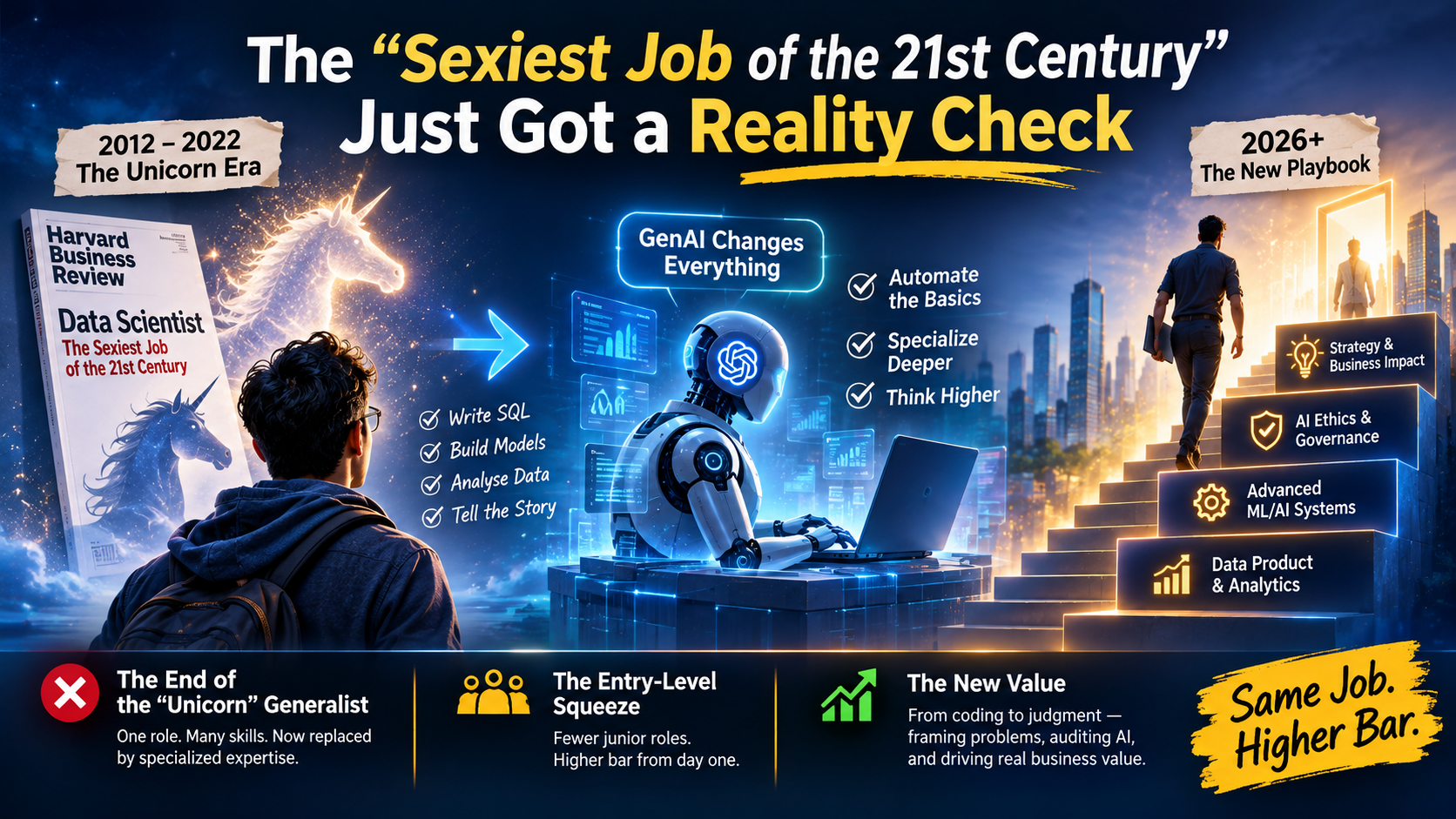
The Death of the "Unicorn" Generalist
A decade ago, companies hunted for data "unicorns"—rare, highly coveted professionals who could simultaneously write complex SQL queries, build statistical models from scratch, and translate those insights for the C-suite.
- What changed: The discipline has completely fractured into hyper-specialized sub-roles like Machine Learning Engineer, Data Engineer, and Analytics Specialist.
- The GenAI shift: Foundation models and AutoML have entirely commoditized the basics. AI now writes clean code, debugs data pipelines, and generates standard predictive models in seconds. The technical grunt work that used to consume 80% of a junior analyst's week is now just a prompt away.
The Entry-Level Squeeze
The most disruptive shift is happening at the bottom of the talent funnel. Because automation handles the baseline tasks so efficiently, the career ladder has lost its bottom rungs.
- The problem: Companies no longer need to hire junior coders simply to fetch and clean data.
- The hurdle: Junior tech job postings have dried up significantly. The barrier to entry is vastly higher, forcing beginners to skip standard code-monkey tasks and immediately prove they can manage AI systems.
The New Playbook: Shifting Up the Stack
Data science remains an incredibly lucrative and critical career, but the daily reality of the job has completely flipped.
Traditional Data Science (2012–2022)GenAI-Era Data Science (2026) Writing manual code to clean messy datasets. Orchestrating AI agents to manage automated pipelines. Coding standard predictive models from scratch. Fine-tuning, auditing, and scaling massive foundation models. Acting as an isolated technical quantitative expert. Focusing on AI ethics, system safety, and strategic execution.
The bottom line: The job is still elite, but the source of its value has changed. The money is no longer in generating the code or building the models—it is in knowing how to frame the business problem, auditing AI systems for hallucination, and ensuring the algorithms actually drive corporate value.